Tel:+86 21 50272979
E-mail:market@seebio.cn
Pioneer of Core Raw Materials for Functional Food Ingredients and Healthcare Supplements in China.
  • 2024-05-27
  • 1140

New Trinder's Reagent

The Trinder reaction, commonly referred to as the "coupling endpoint colorimetric method," was introduced by Trinder in 1969, deriving its name from its originator. Initially, phenol served as the chromogenic agent, but subsequently, over ten compounds were suggested as alternatives, enhancing the reaction's sensitivity significantly. This reaction serves as the foundation for the enzymatic determination of glucose, cholesterol, triglycerides, and uric acid, boasting immense practical value. It finds extensive application in numerous clinical biochemistry tests, encompassing glucose, triglycerides, cholesterol, uric acid, high-density lipoprotein, low-density lipoprotein, and more.


Mechanism of the Trinder Reaction
 
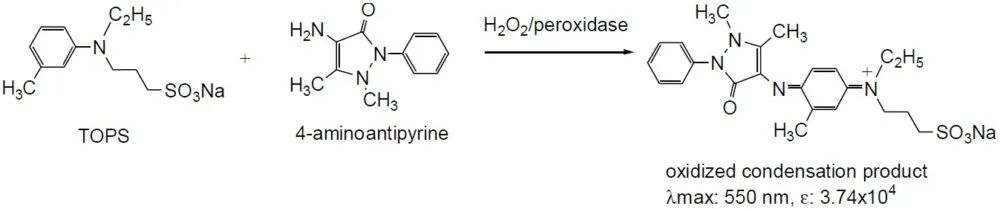
The core principle of the Trinder reaction revolves around hydrogen peroxide (H2O2) produced through enzymatic action of the analyte. In the presence of 4-aminoantipyrine (4-AAP) and peroxidase (POD), this peroxide catalyzes the formation of a red quinone imine compound. Notably, the color intensity of this compound is directly proportional to the metabolite concentration within a specific range.

Employing TOPS as a Substrate in the Trinder Reaction
 
When utilizing Trinder's reagent for enzymatic photometric detection, the analyte's content is determined by measuring the light absorption at its maximum absorption wavelength. However, if impurities in the sample absorb light at the same wavelength as the detection wavelength, it can lead to interference.
 
 
New Trinder's Reagent
 
Traditional Trinder's reagents encompass phenols (phenol, 4-chlorophenol, sodium 2,4-dichloro-6-phenolsulfonate, etc.) and anilines (N,N-dialkylaniline, N,N-dialkyl-m-toluidine, etc.). However, phenols have a narrow absorption wavelength range, and their detection intermediates can potentially disrupt results. Meanwhile, aniline chromogenic substrates require acidic conditions for processing, limiting enzyme use and preventing widespread application in actual testing.
 
The new Trinder's reagent offers several advantages. It boasts higher water solubility, a broader UV absorption range for its color reaction products, a wider acid-base range for the reaction, and greater sensitivity. These features render it more practical for biochemical reactions. Examples of new Trinder's reagents include TOOS, MADB, ADOS, and HDAOS, which are highly water-soluble aniline derivatives. They are commonly used for enzymatic photometric detection of biochemical markers such as blood sugar, blood lipids, liver function, and kidney function.
 
 
Selection Considerations
 
When serum levels of the analyte are low, ALPS, TOOS, and TOPS are preferred due to their superior color sensitivity.
For precise detection, MADB or MAOS are advisable as they have higher absorption wavelengths, minimizing interference from other substances.
The color reaction products of TOOS, ADOS, and DAOS are stable and unlikely to fade.
MAOS is suitable for measurements between 550nm and 600nm, surpassing most interfering substances. While its sensitivity is lower than TOOS, its robust anti-interference capability is ideal for complex samples.
 
 
Product Information
 
Item Number
Product
λmax(nm)
Molar absorbance
DCD0049A
N-(2-Hydroxy-3-sulfopropyl)-3,5-dimethoxyaniline sodium salt; HDAOS, 82692-88-4
583
1.73x10⁴
DCD0006A
3-(N-Ethyl-3-methylanilino)-2-hydroxypropanesulonic acid sodium salt; TOOS, 82692-93-1
555
3.92x10⁴
DCE0552A
N,N-Bis(4-sulfobutyl)-3,5-dimethylaniline disodium salt; MADB, 209518-16-1
630
1.65x10⁴
ACC0083A
N-Ethyl-N-(2-hydroxy-3-sulfopropyl)-3,5-dimethylaniline sodium salt monohydrate; MAOS, 82692-97-5
630
2.25x10⁴
DCC0040A
N-Ethyl-N-(3-sulfopropyl)-3-methoxyaniline sodium salt; ADPS, 82611-88-9
540
2.79x10⁴
ACD0074B
N,N-Bis(4-sulfobutyl)-m-toluidine, disodium salt; TODB, 1044537-70-3
550
3.80x10⁴
DCD0035A
N-Ethyl-N-(3-sulfopropyl)-3-Methylaniline Sodium Salt; TOPS, 40567-80-4
550
3.74x10⁴
DCD0049A
N-Ethyl-N-(2-hydroxy-3-sulfopropyl)-3 5-dimethoxyaniline sodium salt; DAOS, 83777-30-4
593
1.75x10⁴
DCD0004A
Nitro Blue Tetrazolium; NBT, 298-83-9
530
3.6x10⁴
DFG0001A
Iodonitrotetrazolium chloride; INT, 146-68-9
490
1.5x10⁴
ACD0021A
Blue tetrazolium chloride; BT, 1871-22-3
525
2.6x10⁴